
How Can Banks and Vendors Adopt AI to Accelerate Software Development

Leveraging Artificial Intelligence in Banking Software Development
Key Takeaways
- AI accelerates banking software development by automating code generation, legacy system modernisation, and testing workflows, reducing development time by 30–50% whilst improving code quality and security compliance.
- Major banks are implementing AI governance frameworks, automated compliance checks, and security-first development practices to ensure AI-generated code meets stringent financial industry standards.
- Financial institutions deploying AI-powered software development can expect cost reductions of 25–40%, faster time-to-market, and improved team productivity whilst managing regulatory complexity.
The banking sector faces unprecedented pressure to modernise its software infrastructure whilst maintaining regulatory compliance and operational security. Traditional approaches to software development in banking have become increasingly resource-intensive, with legacy systems consuming valuable technical talent and slowing innovation cycles. Today, AI banking software development has emerged as a transformative force, enabling banks and software vendors to accelerate development lifecycles, reduce costs, and deliver competitive advantages in an increasingly digital financial landscape.
This comprehensive guide explores how artificial intelligence in banking is reshaping software engineering practices, the practical frameworks banks are implementing, and the critical steps needed to balance development velocity with security and compliance.
Why AI Banking Software Development Became a Strategic Imperative in 2026
The transformation of financial services software development through AI adoption is not merely a technical upgrade it represents a fundamental shift in how banks architect and maintain their core systems. Three critical drivers have made AI adoption essential:
- Legacy Modernisation Crisis: An estimated 60–70% of banking IT budgets are devoted to maintaining legacy systems. AI-powered code analysis and automated refactoring tools enable banks to modernise these systems whilst continuing operations, dramatically reducing both risk and cost.
- Talent Shortage: The shortage of experienced banking software engineers has intensified. AI code generation and intelligent assistance tools extend the productivity of existing teams, allowing senior architects to focus on high-value strategic work whilst AI handles routine implementation.
- Regulatory Complexity: Banks must navigate an increasingly complex regulatory landscape whilst maintaining competitive time-to-market. AI enables automated compliance checking, security scanning, and documentation—embedding governance directly into development pipelines.
From Code Generation to Legacy Modernisation: AI's Full-Stack Impact
AI's influence across the software development lifecycle extends far beyond automated code generation. AI in banking software applications span multiple layers of development:
Code Generation and Completion: AI assistants analyse developer intent from natural language comments and existing code patterns to generate accurate, contextually appropriate code. This reduces boilerplate implementation time by 40–60% whilst maintaining code quality standards.
Testing and Quality Assurance: AI-driven test case generation creates comprehensive test coverage automatically, identifying edge cases and potential vulnerabilities that manual testing might miss. This accelerates the transition from development to production-ready code.
Security and Compliance Scanning: Real-time AI analysis identifies security vulnerabilities, compliance violations, and architectural issues before code reaches production, reducing post-deployment remediation costs.
Legacy System Modernisation: AI tools analyse legacy codebases, automatically generate equivalent modern implementations, and create migration pathways that preserve business logic whilst reducing technical debt.
Documentation and Knowledge Management: AI generates and maintains accurate technical documentation automatically, ensuring that institutional knowledge remains accessible even as teams evolve.
How Major Banks Deploy AI Across Software Development Lifecycles
Leading financial institutions have adopted distinct patterns for integrating AI in banking software initiatives. Rather than replacing developers, successful implementations augment existing teams with AI-powered tools that enhance decision-making and accelerate repetitive tasks.
Tier-1 Banks' Approach: Global institutions have established dedicated centres of excellence for AI adoption, evaluating tools, defining governance policies, and establishing internal standards. These banks typically implement AI gradually across non-critical systems before expanding to mission-critical infrastructure.
Regional and Community Banks: Smaller institutions leverage cloud-based AI development platforms and managed services, avoiding the infrastructure investment required for in-house AI centres. This democratisation has enabled even resource-constrained banks to benefit from AI acceleration.
Software Vendors: FinTech and software vendors serving banks have integrated AI directly into their development platforms, delivering AI-assisted development capabilities as built-in features rather than additional tools.
Balancing Development Velocity with Security and Compliance Requirements
The central challenge in deploying AI banking software development initiatives is ensuring that increased development velocity does not compromise the stringent security and compliance standards demanded by financial regulators. This requires a deliberate, architecturally-informed approach.
Security-First Code Generation: Banks are training AI models using only code from secure, compliance-verified repositories. This ensures generated code inherits security best practices rather than propagating common vulnerabilities.
Automated Compliance Mapping: AI systems are configured to understand banking regulations (PCI-DSS, SOX, GDPR) and flag code patterns that may create compliance risks, effectively embedding regulatory knowledge into development workflows.
Human-in-the-Loop Validation: Whilst AI can accelerate development, senior engineers retain final approval authority, particularly for security-critical and regulatory-sensitive code. This balanced approach maintains quality whilst capturing AI's productivity benefits.
Building AI Governance Frameworks for Responsible Software Engineering
Successful software development for financial services using AI requires robust governance structures that ensure accountability, auditability, and alignment with organisational values.
AI Model Governance: Banks are establishing policies governing which AI models can be used, how they are trained, who has access, and how their decisions are audited. This ensures consistency with regulatory expectations.
Data Privacy and IP Protection: Organisations carefully control what proprietary code and data are used to train or fine-tune AI models, preventing unintended exposure of intellectual property or sensitive customer information.
Audit Trails and Explainability: Financial regulators demand transparency. Banks are implementing systems that log AI recommendations, track approvals, and can explain why specific code was generated critical for regulatory examinations.
Continuous Monitoring: AI-generated code is monitored in production to identify unexpected behaviour. Systematic feedback from production monitoring is used to improve AI models, creating virtuous cycles of continuous improvement.
Measuring ROI: Cost Savings and Productivity Gains from AI-Powered Development
Early adopters of AI banking software development are reporting measurable returns across multiple dimensions:
Development Time Reduction: Teams report 30–50% reductions in time-to-completion for standard development tasks. Complex features that previously required months can be delivered in weeks.
Cost Savings: Reduced development timelines translate to direct cost savings of 25–40% per project. These savings accrue across the entire development portfolio over time.
Quality Improvements: Automated testing and security scanning reduce post-deployment defects by 20–35%, lowering maintenance costs and improving customer satisfaction.
Team Satisfaction: Developers using AI tools report higher job satisfaction, citing reduced tedium and increased focus on architectural and creative challenges. This improves retention among skilled engineers.
Future-Ready Banking Software: Agentic AI and Autonomous Development Systems
The next frontier in AI in banking software development involves agentic AI systems—autonomous agents that can execute entire development workflows with minimal human intervention. These systems will:
- Autonomously translate requirements into working, tested, and documented code
- Identify and suggest architectural improvements proactively
- Manage deployment and monitoring with human oversight
- Continuously optimise systems based on operational data
Banks preparing for this transition should establish strong foundational practices today—robust governance, security-first development cultures, and human expertise in AI systems oversight. These investments will become increasingly valuable as autonomous systems become more sophisticated.
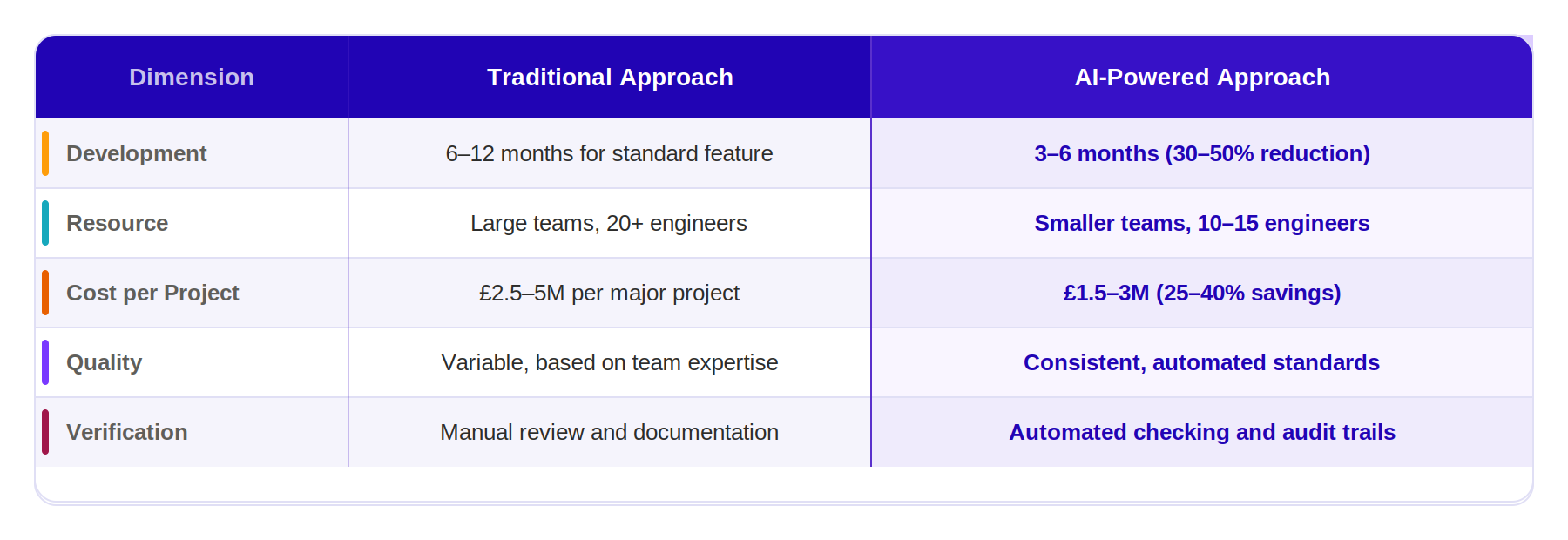
Comparison: Traditional vs. AI-Powered Software Development
The table below illustrates key differences between traditional and AI-augmented development approaches:
Implementation Framework: 5-Phase Roadmap for AI Banking Software Development
Banks implementing AI in banking software development should follow this structured approach:
- Assessment Phase (Weeks 1–4): Evaluate existing development practices, identify high-impact opportunities, assess technical readiness, and benchmark current productivity metrics.
- Pilot Phase (Months 2–4): Select a non-critical project, introduce AI tools to a willing team, establish processes for AI oversight, and measure baseline improvements in velocity and quality.
- Governance Phase (Months 4–6): Formalise AI governance policies, define security standards, establish audit mechanisms, and create training programmes for broader team adoption.
- Scaling Phase (Months 6–12): Gradually expand AI tool adoption across teams and projects, monitor outcomes, refine governance based on learnings, and build in-house AI expertise.
- Optimisation Phase (Ongoing): Continuously refine AI models based on organisational data, stay current with AI tool evolution, and prepare infrastructure for agentic AI systems.
Frequently Asked Questions
How does AI accelerate banking software development compared to traditional methods?
AI accelerates development through automated code generation, intelligent code completion, and automatic test case creation. Rather than writing boilerplate code manually, developers describe intent and AI generates contextually appropriate implementations. Automated testing identifies issues early, reducing feedback cycles. Combined, these capabilities compress typical development timelines by 30–50%, allowing teams to deliver features faster whilst maintaining quality standards and regulatory compliance.
What are the main challenges banks face when implementing AI in software development?
Primary challenges include establishing AI governance frameworks that satisfy regulators, ensuring AI-generated code meets stringent security standards, protecting proprietary code from exposure through AI training pipelines, and managing cultural resistance from teams. Additionally, integrating AI tools into legacy development environments can be technically complex. Banks must also invest in training and build in-house expertise to effectively oversee AI systems and maintain accountability for AI-generated decisions.
Which AI tools are most commonly used for banking software development?
Leading tools include GitHub Copilot (code generation), ChatGPT and Claude (design and implementation assistance), SonarQube with AI extensions (code quality and security analysis), and specialised platforms from vendors like IBM and Deloitte serving financial institutions. Increasingly, banks are evaluating domain-specific tools trained on financial services code. Cloud platforms (e.g., AWS Q Developer, Azure Copilot) provide enterprise-grade alternatives with enhanced security controls and audit trails suitable for regulated environments.
How can banks ensure AI-generated code meets security and compliance standards?
Banks implement layered controls: training AI models using only code from secure, compliance-verified repositories; embedding regulatory knowledge directly into AI systems to flag compliance risks; implementing automated security scanning for AI-generated code; maintaining human review authority for security-critical implementations; and establishing comprehensive audit trails documenting all AI recommendations and approvals. Regular penetration testing and vulnerability assessments verify that AI-generated systems meet security requirements equivalent to or exceeding traditional development.
What cost savings can banks expect from AI-powered software development?
Banks typically see cost reductions of 25–40% per development project. A major feature that cost £2.5–5M traditionally might cost £1.5–3M with AI acceleration. Beyond direct project costs, savings accrue through reduced maintenance (fewer post-deployment defects), faster feature delivery (reaching revenue-generating features sooner), and lower team turnover (improved developer satisfaction). Multi-year savings across a typical bank's portfolio can exceed £50–100M annually, making AI adoption a compelling financial investment regardless of efficiency benefits.
Conclusion
The integration of AI into banking software development is no longer speculative it is an operational reality shaping competitive advantage across the financial services industry. Banks that adopt AI banking software development strategically, with robust governance and human oversight, are delivering software faster, more reliably, and at lower cost than traditional competitors. Financial institutions should begin their AI adoption journey today, starting with pilots and governance frameworks that position them for scaling as AI capabilities mature.
For banks seeking to explore cloud-based architectural approaches to support modern development, cloud lending best practices provide valuable context. Meanwhile, digital transformation in lending explores broader strategic imperatives shaping the industry.
Furthermore, the importance of explainable AI in lending highlights the critical need for transparency in AI-driven systems. Banks implementing AI development tools should ensure these principles extend to their software engineering practices.
For operational efficiency, automated loan processing demonstrates how AI and automation drive value across banking operations. Banks ready to embrace AI-powered software development will position themselves to build these next-generation capabilities efficiently and responsibly.