
ECB Supervisory Priorities 2027-29: What They Ask of EU Banks

Key Takeaways
- Priorities are broadly unchanged from last year: financial resilience to geopolitical and macro-financial shocks, and operational resilience with robust ICT capabilities (1).
- Underwriting is first in the queue. Supervisors plan targeted reviews of creditworthiness assessments in residential real estate and corporate lending, an on-site campaign on underwriting standards, and targeted inspections of loan pricing (1).
- The weakest SREP scores sit in non-financial risk. Governance scores are driven by risk data aggregation and reporting weaknesses, and operational and ICT risk remains among the worst-scored categories (2).
- AI has moved from a watch item into regular supervisory work. The ECB says banks still have further to go on transparency, explainability and data governance (1).
- ezbob's contribution is specific: bank-controlled, version-controlled credit policy implementation, tamper-evident decision record, single reporting data layer and a documented exit route. It does not calculate risk-weighted assets, and it is not a climate-risk or cyber-defence product.
On 19th November 2026, the European Central Bank (ECB) Banking Supervision division published its supervisory priorities for 2027-29 alongside the aggregated results of the 2026 SREP. The headline is continuity: two priorities, five vulnerabilities, and a programme of targeted reviews and on-site inspections that falls squarely on how banks originate credit, evidence decisions and manage data. This post sets out what supervisors have said they will examine, and shows where the ezbob platform helps a bank meet those expectations and, just as plainly, where it does not.
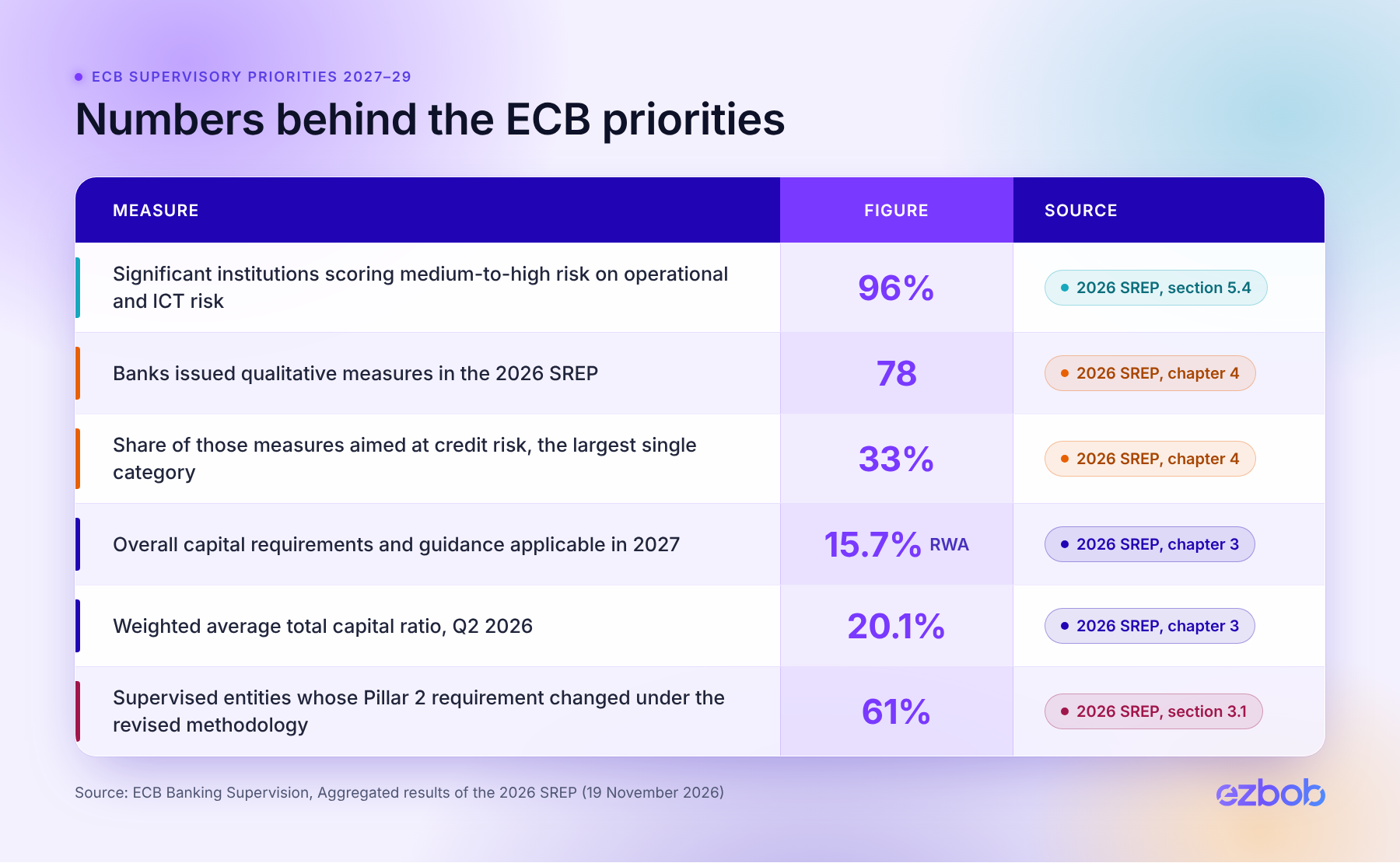
Capital is not the problem. The sector holds a buffer of more than four percentage points over requirements and guidance; what supervisors are pressing on is the quality of the processes underneath.
Priorities, at a Glance
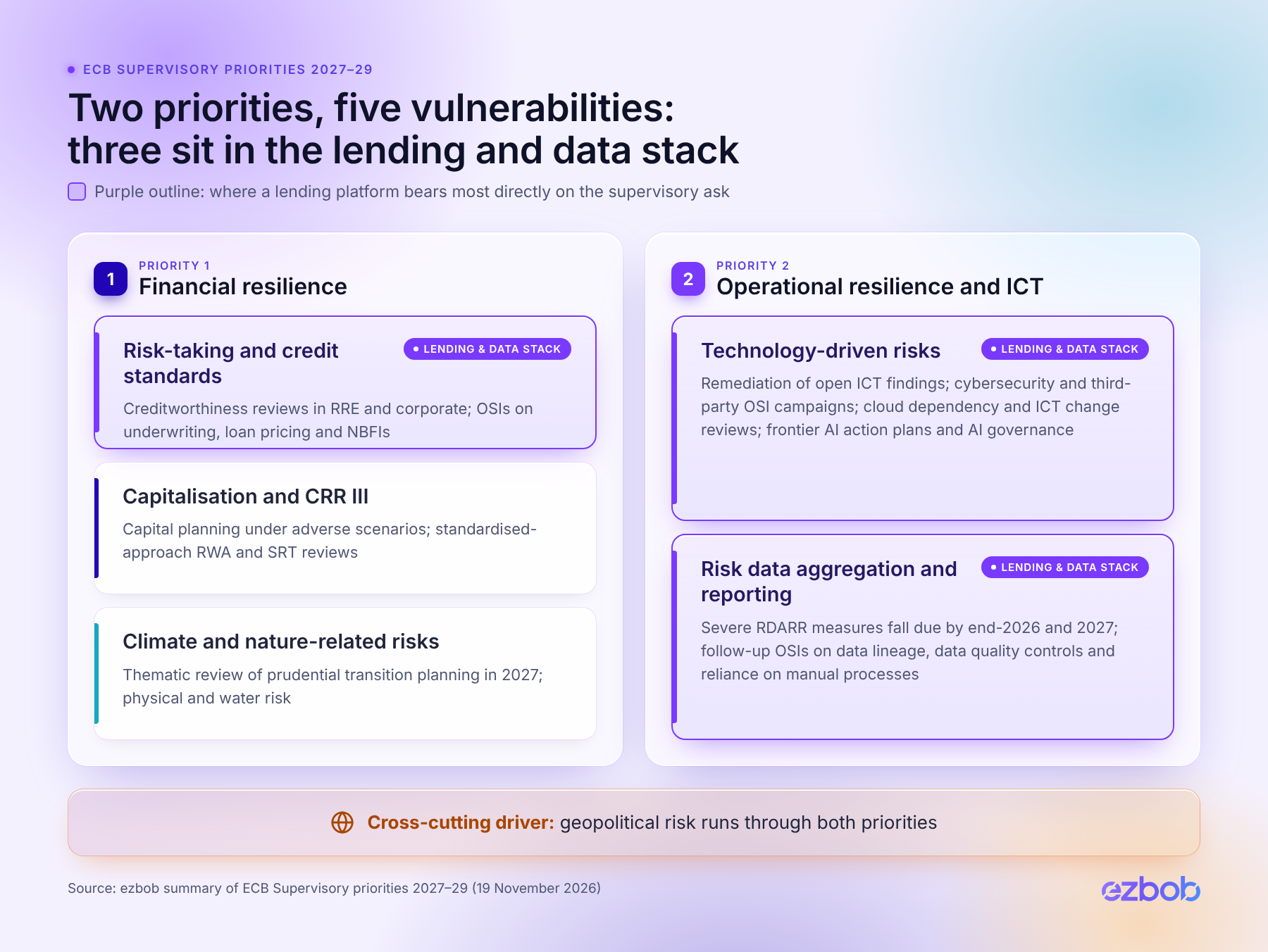
Each priority targets named vulnerabilities, and each vulnerability comes with a strategic objective and a list of planned supervisory activities (1). One structural change is worth noting: last year's separate medium-term strand on digital and AI strategies has been folded into regular work on technology-driven risks, so AI governance is now examined as part of operational resilience, not beside it. The ECB's own version of this picture is Figure 1 of the priorities document.
What SREP found, and what Supervisors will Examine
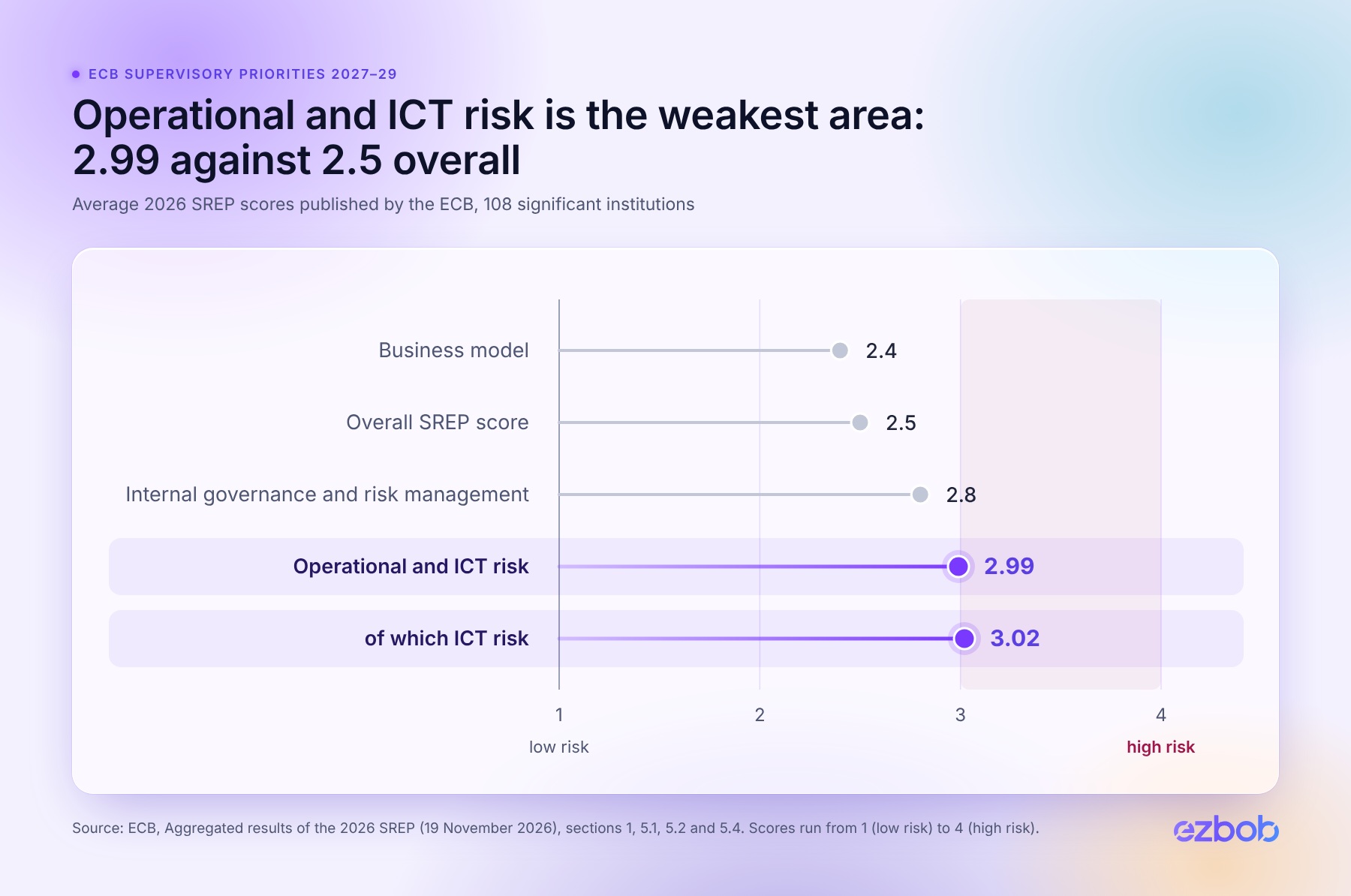
Scores run from 1 (low risk) to 4 (high risk). The ECB publishes averages for these elements only; credit risk and capital adequacy are reported as distributions, and both are described as broadly stable (2). The pattern is consistent with the priorities: the financial numbers are sound, and the concern is concentrated in governance, data and technology.
Priority 1: Financial Resilience
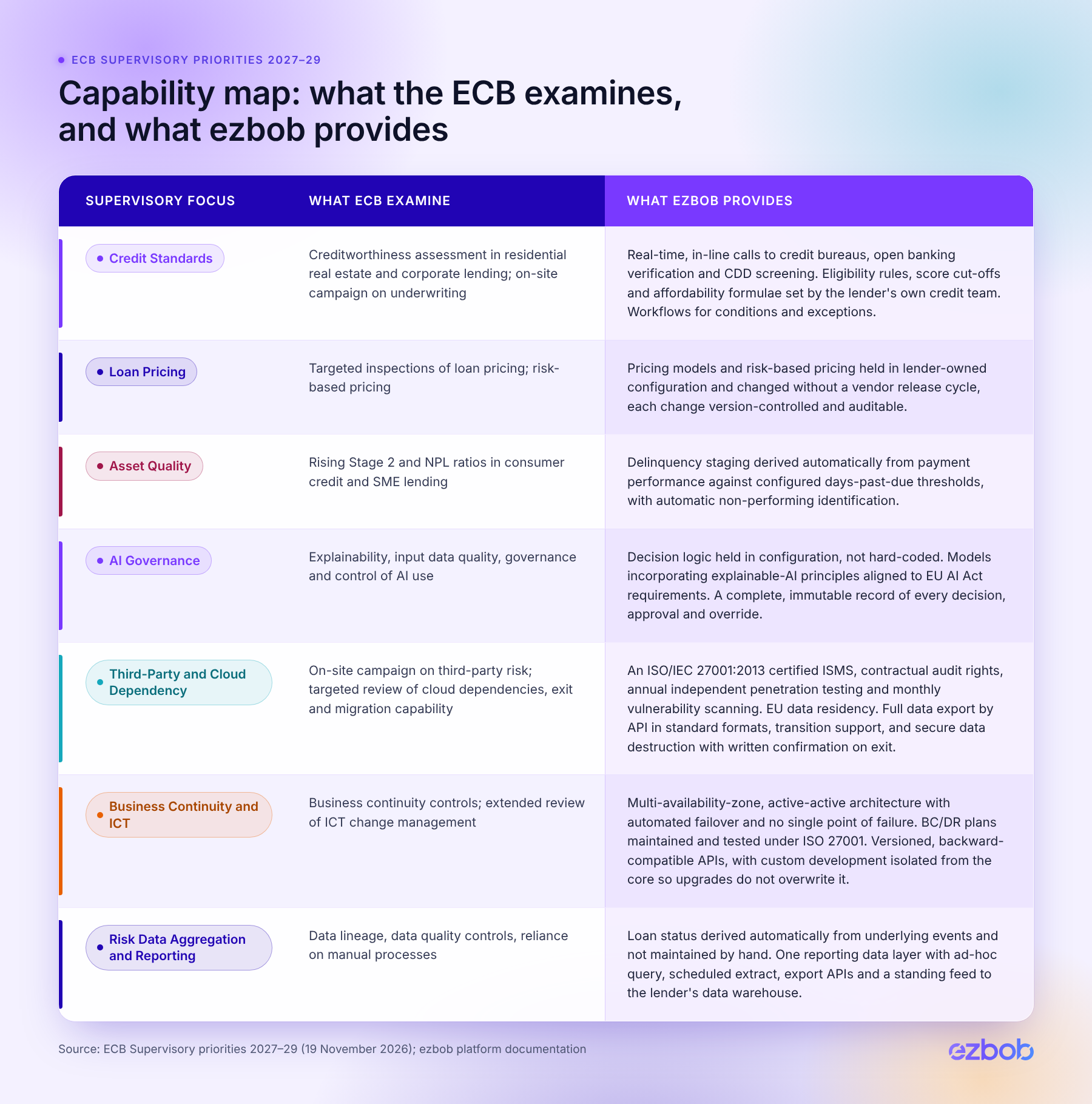
Credit standards. Asset quality has held up, with non-performing loan ratios low and mortgage books resilient. The exceptions are instructive. The ECB reports consumer credit NPL and Stage 2 ratios rising significantly, material SME deterioration in some countries, and continued uncertainty in commercial real estate; cost of risk has already risen for most banks (1). The 2026 thematic review of underwriting will therefore be followed by off-site work on creditworthiness assessment in residential real estate and corporate lending, an on-site campaign on underwriting standards, and targeted inspections of loan pricing. The SREP itself issued 70 credit-risk measures to 37 banks, and links poor origination practice directly to the build-up of non-performing loans (2).
Capital and CRR III. Supervisors will keep testing how credit risk-weighted assets are calculated under the more granular standardised approach, through a targeted review and an on-site campaign. The phase-in has so far raised Pillar 1 requirements noticeably for around one-third of supervised entities and reduced them for around 60% (2). Capital planning under adverse scenarios remains a stated weakness, and the 2027 EU-wide stress test will include climate transition and physical risk for the first time (1).
Climate and nature. With the five-year programme closed, the focus shifts to prudential transition planning, which gets a thematic review in 2027, and to physical risk, with targeted inspections of water-related risk planned for 2028 (1).
Priority 2: Operational Resilience and ICT
Technology-driven risks. In the 2026 cycle 16% of banks improved their operational and ICT score and 13% were downgraded, the downgrades driven by rising operational losses, persistent control deficiencies, gaps in implementing DORA and third-party risk (2).
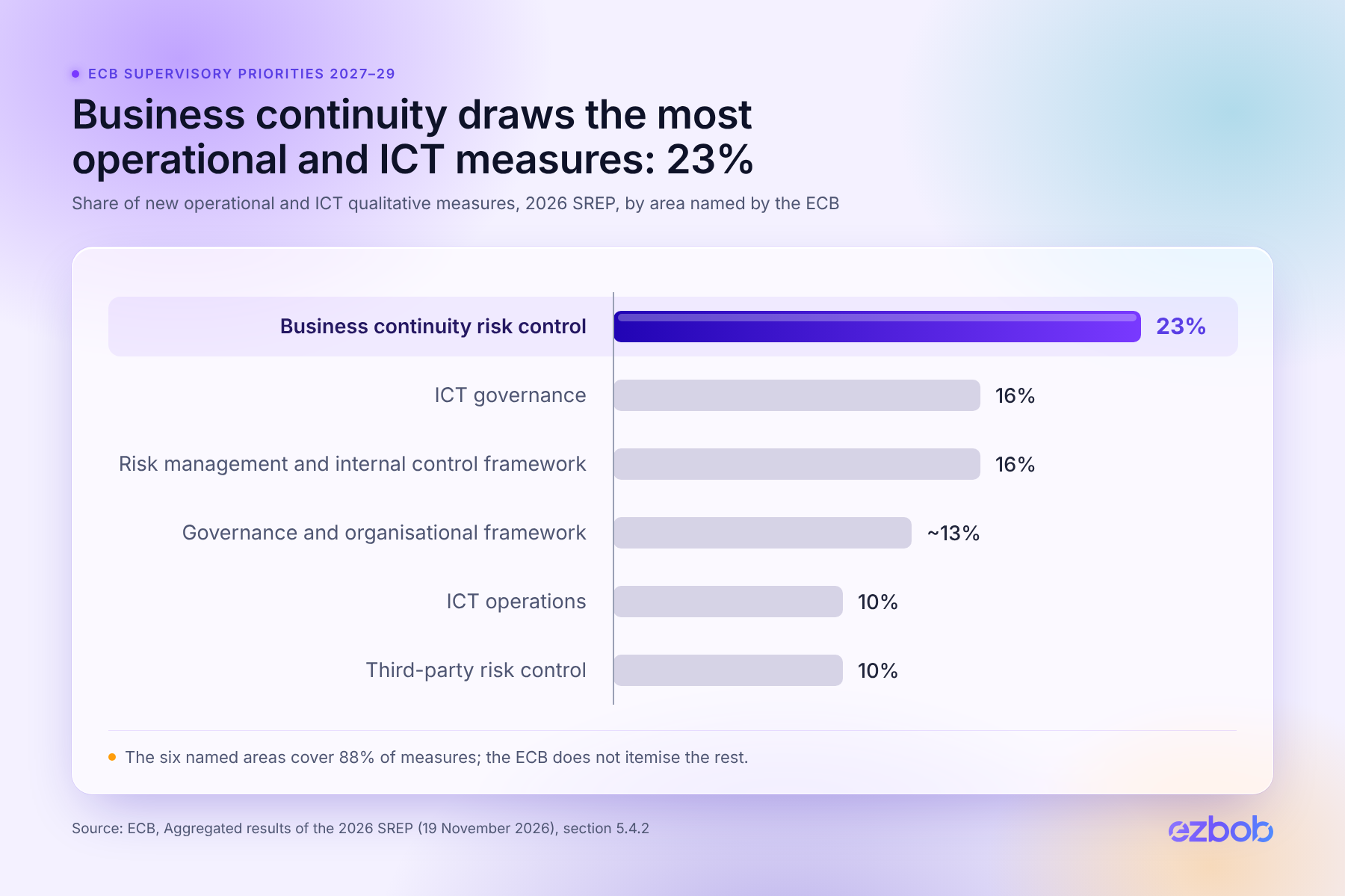
The supervisory response is a system-wide push to close open ICT findings, on-site campaigns on cybersecurity and third-party risk, a targeted review of cloud service provider dependencies, and an extended review of ICT change management, which the ECB identifies as a primary root cause of unscheduled downtime (1, 2). On AI, supervisors will analyse banks' action plans in response to the Dear CEO letter on AI-enabled cyber threats, and run pilot off-site and on-site reviews of AI governance at a limited number of banks. The topics named for engagement with industry are model accuracy and explainability, the quality of input data, and the prudential materiality of AI risk.
Risk Data Aggregation and Reporting. Governance scores are driven largely by RDARR weaknesses, which account for 27% of new governance measures (2). The deficiencies the ECB lists are familiar: IT and data architectures, data lineage, data quality controls, reliance on manual processes and recurring reporting errors. Many severe measures fall due by the end of 2026 and during 2027, and the ECB states it will use its supervisory powers where remediation falls short (1).
How ezbob technology supports each priority
ezbob provides credit underwriting and lending origination infrastructure to banks and non-bank lenders. Its governing design principle is that the bank must always be in control of the process: credit policy, product design and customer experience belong to the lender, and the platform exists to make them executable, changeable and evidenced. That principle maps closely onto what supervisors test, because almost every planned review asks the same underlying question: can the bank clearly evidence what it decided, on what data, under which policy, and who changed that policy when?
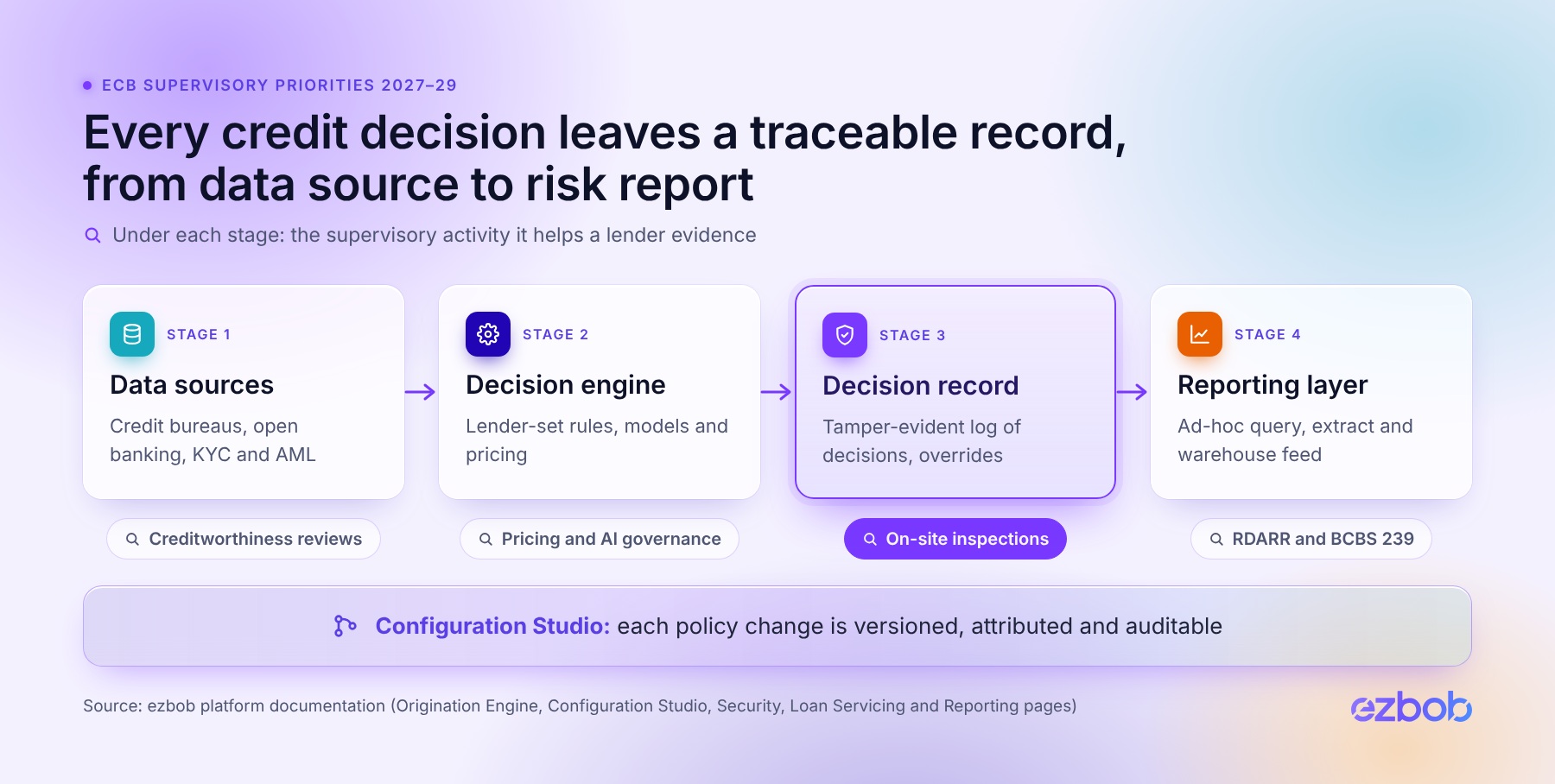
The decision record is the centre of the picture. Every decision event, state change and user action is logged in a tamper-evident audit trail, and every change to credit policy, product rules or workflow logic is stamped with its author, timestamp and prior state (E1, E2).
Capability Map
What to do in the next twelve months
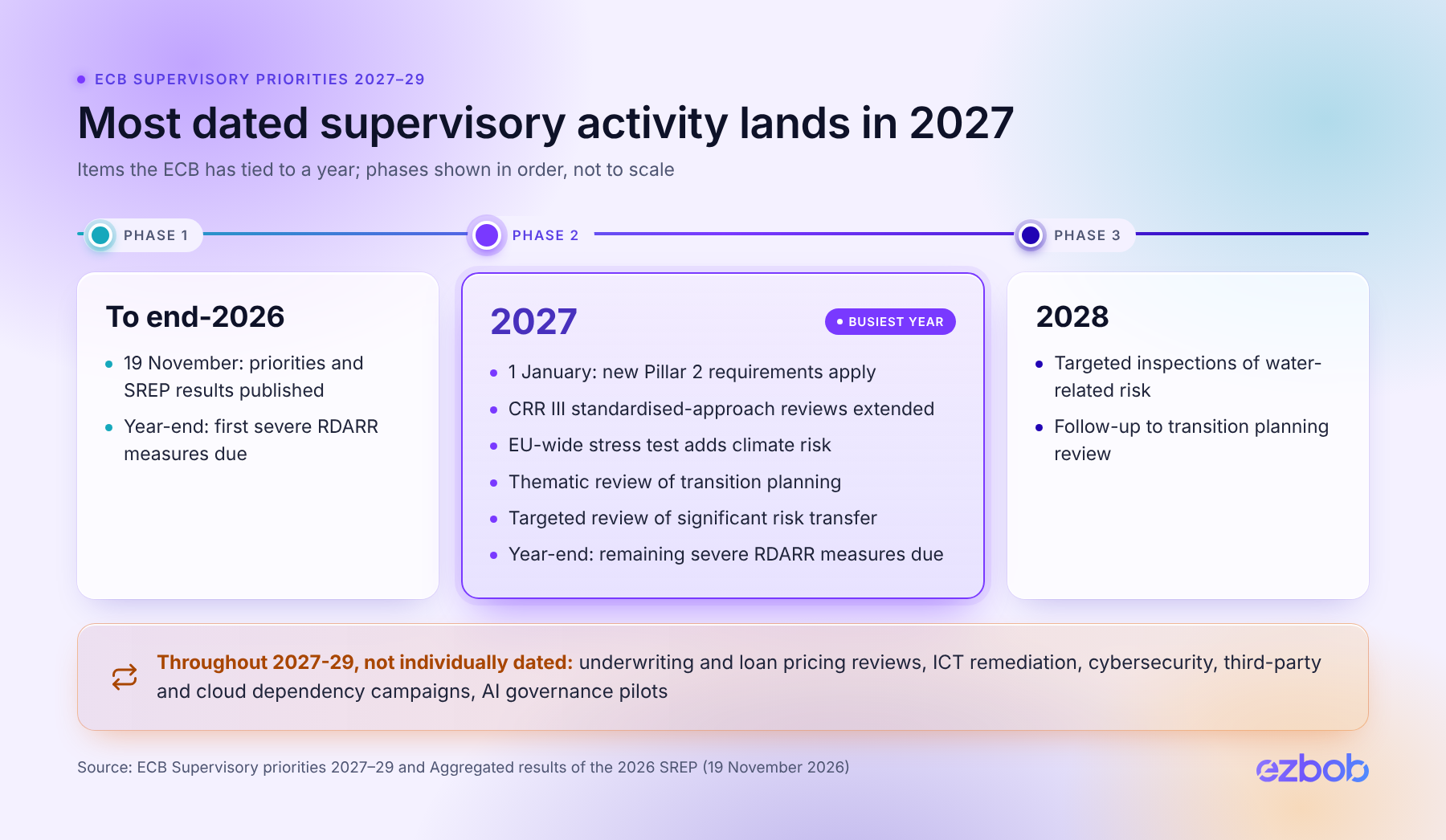
The dated items are mostly capital and climate exercises. The work that touches lending operations most directly, on underwriting, pricing, third-party risk and AI governance, runs through the whole period without published dates, which is an argument for preparing now and not waiting for a notification letter (1).
Five actions follow from the ECB's own description of what it will test.
- Benchmark new-lending standards against the 2026 underwriting review, and confirm that every policy rule has an owner and a change history.
- Pick a recent pricing decision and reconstruct it: which model, which version, which inputs, who approved the last change.
- Trace one risk report back to its source fields, and count the manual steps on the way. Each one is a data-quality finding waiting to be written.
- Refresh the register of ICT third-party arrangements, and hold a tested exit plan for every provider that supports a critical function.
- Inventory where AI informs a credit decision, and document the explainability and input-data controls for each use.
Get in touch with us
Supervisors have told banks what they will look at and, in broad terms, when. If you would like to see how the ezbob platform evidences credit decisions, policy changes and data lineage against that programme, please contact Francesco Manitta or Yaron Shoshani at [email protected] today.
Frequently Asked Questions
Do the priorities apply to banks the ECB does not supervise directly?
They are set for significant institutions. The ECB says they also serve as a reference for national supervisors when setting proportionate oversight strategies for less significant institutions (1).
What has changed since the 2026-28 priorities?
Little in structure. AI and digital strategy has moved into regular work on technology-driven risk, and there are new on-site campaigns on fund financing and non-bank exposures, a targeted review of significant risk transfer, and a sharper focus on physical climate risk (1).
Does ezbob calculate capital requirements?
No. Risk weighting and capital calculation stay in the lender's finance and risk systems; ezbob supplies the loan-level data they rely on.
Can a lender change credit policy without ezbob's involvement?
Yes. Rules, score cut-offs, pricing and workflow settings are managed by the lender's team in the Configuration Studio, with a full history of who changed what and when.
Sources
- European Central Bank, Supervisory priorities 2027-29, published 19 November 2026.
- European Central Bank, Aggregated results of the 2026 SREP, published 19 November 2026