Open Banking and AI Agents: The Consent Layer for Lending

Key Takeaways
- Every lending decision that uses bank data depends on a consent record showing who approved access, to what, for how long and how that can be proved later.
- Open banking rules were designed for a person approving one thing at a time, and software acting repeatedly on a customer's behalf stretches those assumptions.
- Lending raises consent problems that payments never had to solve, including affordability checks and disputes that can surface years after the loan was made.
- The proof a regulator wants lives in the decision systems, so consent cannot be bolted on at the front end.
What the Consent Layer Is
Let’s start with the plumbing. An Open Banking API is a secure, standardised interface through which a bank lets a regulated third party read a customer's account data or initiate a payment, but only after the customer has given explicit permission and authenticated with their own bank. In lending, that third party is usually an account information service provider (AISP) retrieving transaction history so the lender can verify income and assess affordability.
The consent layer is everything around that call. It is how a lender records who approved access, what exactly was approved (which accounts, which data, for which purpose), for how long the permission lasts and whether it has been renewed or withdrawn, and how all of that can be proved later to a customer, an ombudsman or a regulator. In the UK, for example, an AISP must obtain the customer's reconfirmation every 90 days to keep access alive, a rule the FCA introduced to replace repeated bank re-authentication.
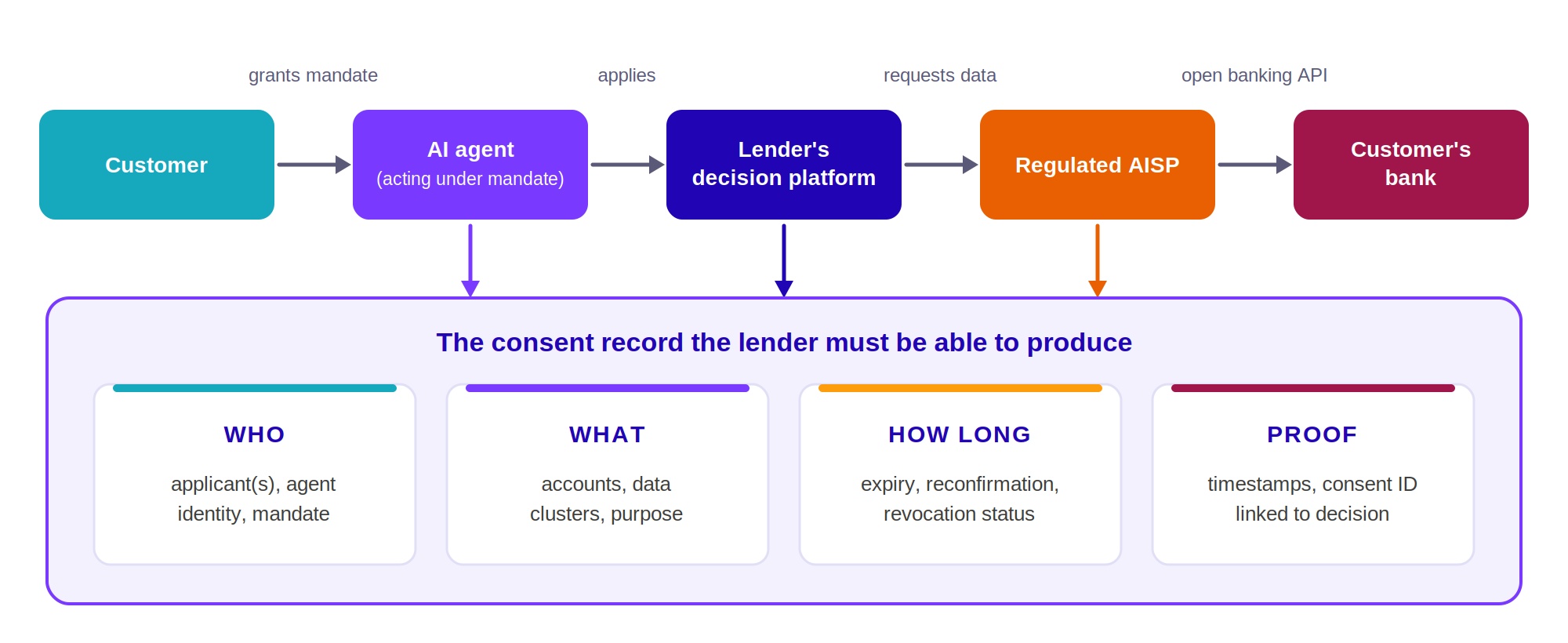
Figure 1: Consent layer. Each hop must leave evidence the lender can produce later.
ezbob's open banking connections are built on this model. In the UK the platform uses both Plaid and Equifax, both acting as FCA-authorised AISPs, receiving and processing customer consent and giving customers a view of every party with access to their data, with the ability to revoke it at any time.
Why Rules Built for People Do Not Work for Software
Open banking rules assumed a person, present at a screen, approving one discrete thing for a set period. Authentication proved the person was there and the expiry date bounded the risk.
AI agents break each assumption quietly. An agent may act on a standing mandate rather than a single instruction. It may repeat requests, or move from comparing offers to applying to requesting a limit increase, all under one goal the customer set weeks earlier. The FCA's Mills Review, published in July 2026, describes exactly this shift: retail financial services moving from human-led activity towards services that are AI-enabled, continuous and delegated. FCA-commissioned research found around a fifth of UK adults, roughly 11 million people, would consider using AI that acts on its own within limits they set.
None of this is a flaw in the old rules. They were written for a different way of working. The question simply shifts from 'is this the customer?' to 'is this software acting within what the customer actually authorised?', and AI agent authentication has to answer the second question as reliably as Strong Customer Authentication answers the first.
Five Consent Problems That Only Apply to Lending
Most of what has been written about agents and open banking concerns payments. Lending is different, because a loan creates an obligation that outlives the transaction and a regulatory duty to assess whether it is affordable.
- Who Counts as the Applicant? Joint mortgages, guarantors and SME directors mean several people's data can feed the same decision: consent from one account holder, or from an agent acting for them, does not cover another person's accounts. Each party needs a separate, attributable permission, and the lender must be able to show which data came from whom.
- What about one-time versus standing permission? An application needs a single snapshot of transactions. Ongoing credit line reviews, early-warning monitoring or a later refinance need continuing access. The two must be separate permissions with separate purposes, and a one-time consent given for an application must never quietly become standing access.
- Where affordability checks when nobody reads the small print? UK consumer lenders must carry out a reasonable creditworthiness assessment based on sufficient information and consider the risk that repayments are unaffordable. If an agent gathers the data, completes the application and accepts the terms, the human may never have read anything. The lender still needs to show the assessment was sound and that the borrower, not just the software, understood the commitment.
- How do I prove the software is allowed to act? A lender must be able to show that the agent was acting for this customer, within the scope of this mandate, at the time of this request. That means binding the agent's identity to the customer's identity and to the specific permissions granted, and checking all three on every call, not only at the first.
- What to record for a later dispute? Complaints about lending can arrive years after the loan. The lender needs the consent artefact, the data actually retrieved, the version of any categorisation or model applied to it, the rules that fired, the decision, and every message sent to the customer, all linked by a single identifier.
What PSD3 Changes
The EU's payments reform splits today's framework into two instruments. The Payment Services Regulation (PSR) carries the conduct rules, including open banking access, strong customer authentication and fraud liability. Because it is a regulation, it applies directly in every member state without national legislation. The Third Payment Services Directive covers licensing, supervision and safeguarding, and each member state has to transpose it into its own law.
One point is often misread: directly applicable does not mean immediate. Both instruments are expected to apply around 21 months after entry into force, with verification-of-payee rules later still.
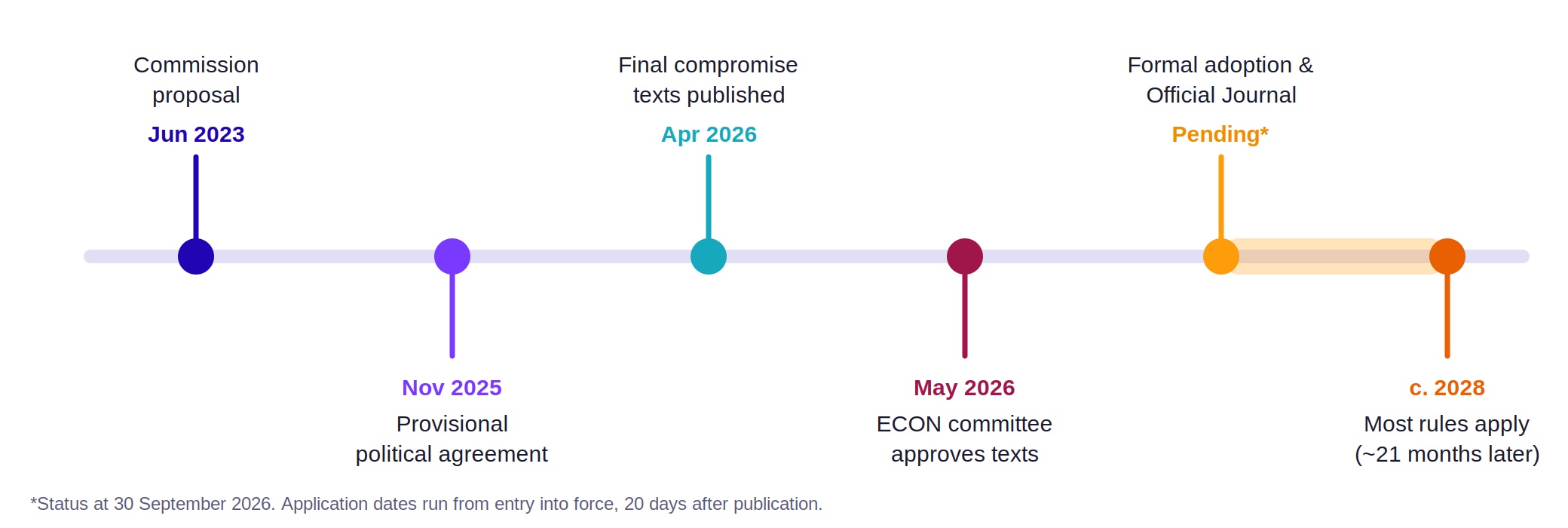
Figure 2: Legislative path of the EU payments, status at 30 September 2026.
The timetable has moved several times this year. The Parliament and Council reached provisional agreement on 27 November 2025, the Council published final compromise texts on 23 April 2026, and the Parliament's ECON committee approved them in May, with its chair pressing for plenary adoption by September at the latest. At the time of writing, trackers still show formal adoption and publication in the Official Journal as pending, which points to most rules applying around 2028. Readers should check the current position before relying on any date.
For lenders using bank data, three changes matter most. Banks must give customers a permissions dashboard to see and withdraw access granted to third parties. After the bank applies strong customer authentication at the first access, the AISP applies its own authentication at least every 180 days, moving that duty from the bank to the data user. Banks face a clearer list of prohibited obstacles to third-party access.
What Lenders Need to Put in Place
This is where most consent management open banking programmes fall short: they capture a tick-box at the front door and nothing afterwards. A lender preparing for agent-driven applications needs four capabilities, plus separate permissions for each joint applicant, guarantor or director.
- Permissions that last but can be unilaterally withdrawn at any time. Purpose-bound standing permissions with explicit expiry, reconfirmation on the regulatory cycle (90 days in the UK, 180 days under the new EU rules), and revocation that reaches decision and monitoring systems within minutes, whichever side it starts from.
- Checks that do not block automated flows. Authenticate the customer, the agent and the mandate once with strength, then verify short-lived, scoped tokens on every call, stepping up only when risk signals change.
- Fraud controls that can separate normal software activity from abuse. Baselines for legitimate agent traffic, limits on request velocity, alerts when an agent asks for data outside its mandate, and separate treatment for agents known to act for the customer versus unknown automation.
- A full record from request to decision. One consent identifier attached to every data pull, derived feature, rule outcome, model version, decision and customer communication, retained for as long as a complaint could reasonably arise.
What This Means for Your Lending Platform
Consent cannot be added at the front end. The proof a regulator wants, that this data, obtained under this permission, produced this decision, sits in the decision systems. If the origination platform cannot link a consent to the features, rules and model version it fed, the lender has a consent log and a decision log but no evidence connecting them.
That is the practical test for agentic AI in banking: not whether an agent can complete an application, but whether the platform behind it can prove afterwards that every step was authorised. ezbob's platform integrates open banking through Plaid and Equifax AccountScore alongside bureau, identity and fraud sources, exposes every function through documented REST APIs secured with OAuth2 and JWT, and writes every decision event, state change and user action to a tamper-evident audit trail. Its affordability tooling lets a permissioned back-office user see the analysis beneath an open-banking-based decision, adjust parameters and recalculate, so a human can review what the automation concluded. For background, see our articles on the benefits of open banking, how open banking drives embedded finance, agentic AI in lending and EU instant payments reporting.
FAQ
What is the difference between open banking and open finance?
Open banking covers payment accounts: current accounts, their balances and transactions, and payments from them. Open finance extends consented data sharing to savings, mortgages, pensions, investments and insurance. In the UK the Data (Use and Access) Act 2025 provides the legal basis for such schemes. We cover the transition in from open banking to open finance.
Does PSD3 apply in the UK?
No. The UK left the EU before the reform was agreed and runs its own regime under the Payment Services Regulations 2017 and FCA rules. The government is building a long-term open banking framework under the Data (Use and Access) Act, with oversight moving to the FCA. UK lenders serving EU customers through EU entities will still be affected.
How long does an open banking permission last?
It depends on where you operate. In the UK, the customer authenticates with their bank at first access and then reconfirms consent with the AISP at least every 90 days. In the EU, the bank currently re-authenticates every 180 days; under the new regulation the AISP takes over that 180-day cycle. A lender's own purpose may justify shorter permissions.
Who is liable if an AI agent makes a mistake with a customer's money?
The law is still settling. Unauthorised payment rules protect customers where they did not consent, and a regulated firm that deploys an agent remains responsible for the outcomes it delivers, including under the Consumer Duty. Beyond that, contracts between the agent provider, the lender and the data provider allocate liability. The Mills Review signals that regulators are examining delegated services closely.
To learn more and to discuss your needs and requirements, please contact Francesco Manitta or Yaron Shoshani at [email protected] or +44 1375 887390.
References
- Open Banking Limited, FCA publishes changes to 90-day reauthentication rules (PS21/19, 29 November 2021). https://www.openbanking.org.uk/news/fca-publishes-changes-to-90-day-reauthentication-rules/
- Financial Conduct Authority, AI and the future of retail financial services (The Mills Review, 6 July 2026). https://www.fca.org.uk/publications/corporate-documents/mills-review
- Mortgage Professional (MPA UK), Mills Review sets out seven recommendations for regulators and firms (July 2026). https://www.mpamag.com/uk/mortgage-industry/technology/fca-review-examines-ais-role-in-financial-services-by-2030/581380
- Financial Conduct Authority Handbook, CONC 5.2A Creditworthiness assessment. https://www.handbook.fca.org.uk/handbook/CONC/5/2A.html
- Freshfields, PSD3/PSR: what the EU's new payments rules mean for your business (2026). https://www.freshfields.com/en/our-thinking/blogs/risk-and-compliance/psd3-psr-what-the-eus-new-payments-rules-mean-for-your-business-102mrom
- Arthur Cox, PSD3 and PSR: final compromise texts published (2026). https://www.arthurcox.com/insights/psd3-and-psr-final-compromise-texts-published/
- Lexology, Payments Insights #6: EU legislative drafting status of PSD3 and PSR (May 2026). https://www.lexology.com/library/detail.aspx?g=f75b134a-064c-45a6-9365-751ae829d613
- Open Banking Tracker, PSD3 and PSR for developers: readiness, timeline and what changes (September 2026). https://www.openbankingtracker.com/guides/psd3-psr-readiness
- Financier Worldwide, Open banking and open finance: outlook for ASPSPs and data holders. https://www.financierworldwide.com/open-banking-and-open-finance-outlook-for-aspsps-and-data-holders
- Herbert Smith Freehills Kramer, UK Smart Data Strategy: building on open banking's momentum (2026). https://www.hsfkramer.com/notes/fsrandcorpcrime/2026-posts/uk-smart-data-strategy-building-on-open-bankings-momentum